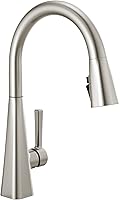
Kitchen Faucets: Pull-Down, Touchless and Commercial Style
The right kitchen faucet fits your sink, reaches where you need to rinse and has comfortable controls. Start with the mounting holes, then choose a pull-down, pullout or touchless setup based on how you use the sink.
On this page (9 sections)
- What should you check before choosing a kitchen faucet?
- Which kitchen faucet sprayer style fits your routine?
- Should you choose a touchless kitchen faucet?
- Do commercial-style kitchen faucets fit a home kitchen?
- How should the faucet fit your sink holes?
- What handle and finish should you choose?
- Which kitchen faucet examples suit different needs?
- What should you check if a faucet has a problem?
- How do you choose a kitchen faucet that fits?
The right kitchen faucet fits your sink, reaches the places you need to rinse, and has controls you can use comfortably. Start with the mounting holes, then choose a pull-down, pullout or touchless setup based on how you use the sink.
A tall spout may help with filling large pots, but it needs enough clearance below nearby cabinets. A flexible sprayer can help rinse the corners of a sink, while a fixed spout may suit a sink that rarely needs extra reach.
Use this guide to compare faucet styles, check fit before buying, and narrow the choices by controls and finish. For a short checklist on the same decision, see how to choose a kitchen faucet.
What should you check before choosing a kitchen faucet?
Check sink holes, counter space and spout clearance first. Those details determine which faucets can fit and move freely in your kitchen.
Measure the number and spacing of holes in the sink or counter. A faucet made for one-hole installation may also work with a three-hole setup if it includes or accepts a suitable deck plate.
Verify the installation instructions for the model you choose. Check both the hole spacing and the mounting opening before buying.
Next, look at the faucet’s height and depth alongside the cabinets, windows and backsplash. Consider whether a tall spout would get in the way, or whether a short faucet would make it hard to fill a pot.
Think through the tasks you do at the sink, such as rinsing baking trays, filling a kettle or washing vegetables. Those tasks help you decide how much sprayer reach you need.
If you’re unsure whether your sink layout will fit a replacement, compare the measurements in are all kitchen faucets the same size?. The hole count is only one part of fit; faucet reach and nearby obstacles matter too.
Which kitchen faucet sprayer style fits your routine?
A pull-down or pullout faucet suits you when you want to bring the water closer to the task. A fixed spout can work if the sink is easy to reach and you rarely need to direct water outside its normal stream.
Pull-down kitchen faucets
The sprayer head on a pull-down faucet moves down from the spout. This can make it easier to rinse around the basin or direct water into a pot sitting in the sink.
Look at how the sprayer docks after use and whether the head switches between stream and spray modes. Those details affect how you handle everyday rinsing and put the faucet back in place.
Pullout faucets
A pullout wand is drawn outward toward you. This style can be useful when you want the hose to reach beyond the basin, such as filling a container on the counter.
The faucet’s overall shape and where the hose travels matter as much as the label. Compare the handle and spout positions with the space behind the sink.
To compare both layouts directly, read pull-down vs pull-out kitchen faucets. Think about the direction you want the sprayer to move and where the hose will be easiest to handle.
Fixed spouts
A fixed spout has no pullout or pull-down wand. It can suit a smaller sink or a routine that mostly involves washing hands and filling dishes directly under the faucet.
Before choosing one, decide whether its fixed reach will cover the areas you use. If you often rinse food or wash large items, a separate sprayer may offer more flexibility.
Should you choose a touchless kitchen faucet?
Choose a touchless faucet if sensor activation fits your kitchen routine and you’re comfortable with its power setup. Check the sensor, controls and power source before installation.
Touchless features are not identical across models. Check what comes with the specific faucet and how its sensor works before deciding.
If you often handle raw ingredients or sticky food while cooking, hands-free activation may be useful. Check how the faucet combines its sensor with temperature and flow controls.
The Moen Arbor Touchless (7594EWSRS) includes 6 AA batteries, a control box and a deck plate. Its MotionSense Wave sensor turns water on and off, and an optional AC power connection is available.
Its pull-down sprayer adds reach for rinsing around the sink. Allow space beneath the sink for the control box and check the installation instructions before choosing it.
For a closer look at the trade-offs, see are touchless kitchen faucets worth it?. If your sensor faucet has stopped responding, see Moen touchless faucet problems or Delta touchless faucet problems.
Do commercial-style kitchen faucets fit a home kitchen?
A commercial-style faucet can suit a home kitchen if its height, reach and overall size fit the sink area. Compare its dimensions with your cabinets and the tasks you want it to handle.
These faucets often have a more prominent shape than a compact residential design. Before choosing one, check how much space remains for a window, shelf or cabinet door to open.
Think about how the faucet will look beside the sink as well. A high, exposed coil may become a focal point, while a lower profile can blend more easily into a smaller kitchen.
See our commercial-style kitchen faucet guide for options in this style. If you want a pull-down faucet without that look, compare the best pull-down kitchen faucets.
How should the faucet fit your sink holes?
Match the faucet’s installation method to the holes already in your sink or counter. If you want to cover extra holes, check whether the faucet includes a deck plate or supports one that fits.
A faucet with a deck plate can cover unused holes in some three-hole sink layouts. The plate does not make every faucet fit every sink: check the hole spacing and the faucet’s installation instructions.
For a one-hole faucet, confirm that the existing opening suits the installation. Also check where the handle sits, how far it moves and whether the backsplash or window frame blocks it.
Read 1-hole vs 3-hole kitchen faucets for a focused comparison. If you’re replacing a faucet, the guides on how to remove a kitchen faucet and how to replace a kitchen faucet cover the next steps.
What handle and finish should you choose?
Choose a handle and finish that work with your sink area and are easy for you to use. Check the handle’s movement and consider how visible fingerprints and water spots may be on the finish.
A single handle can control temperature and flow. Check its position before buying, especially if it needs to swing toward a wall or backsplash.
Finish names can vary between brands. Compare the faucet’s finish with your other fixtures, and consider how much wiping you’re willing to do.
For finish ideas, see kitchen faucet finishes, gold kitchen faucets and matte black kitchen faucets.
Which kitchen faucet examples suit different needs?
These four faucets show how sprayer style, sink fit and controls can guide your choice. Compare their features with your mounting holes, available clearance and daily rinsing tasks.
Moen Adler Pulldown (87233SRS): pull-down with two spray modes
The Moen Adler Pulldown (87233SRS) has an aerated stream and a rinse mode. It fits one- or three-hole installations and comes with a deck plate, which gives you options for covering unused holes.
Moen says the Adler’s Power Clean technology provides up to 50% more spray power. Moen also says its Spot Resist Stainless finish resists fingerprints and water spots.
Consider it if you want a single-handle pull-down faucet with two spray modes. Its height is 14.56 inches and its depth is 7.5 inches, so compare those measurements with your cabinets and sink.
Delta Nicoli Pulldown (Brushed Nickel): a simple pull-down layout
The Delta Nicoli Pulldown (Brushed Nickel) fits one-hole or three-hole 8-inch-center installations with the included deck plate. Its MagnaTite docking uses an integrated magnet to hold the sprayer in place.
Delta says the Nicoli’s ceramic disc valve is tested to last at least 500,000 uses. Delta also says its Brilliance finishes are tested for corrosion resistance.
Consider it if magnetic docking and the brushed finish suit your needs. Its height is 17.06 inches and its depth is 11.06 inches, so check your available space.
Moen Renzo Pullout: an outward-moving wand
The Moen Renzo Pullout is a one-handle faucet with a retractable pullout hose. It includes an optional deck plate for three-hole installation, and Moen says its Spot Resist Stainless finish resists fingerprints and water spots.
The Renzo has a Duralock quick-connect system and Power Clean spray technology. Its height is 9.38 inches, which makes it worth comparing if you have limited space above the sink.
Consider it if you prefer a wand that draws outward toward you. Check the installation requirements for your sink and compare its 9.63-inch depth with the available space.
Moen Arbor Touchless (7594EWSRS): sensor activation and a pull-down wand
The Moen Arbor Touchless (7594EWSRS) combines touchless activation with a pull-down sprayer. It includes 6 AA batteries, a control box and a deck plate, with optional AC power available.
Its sensor and lever handle may suit a kitchen where you want hands-free activation alongside handle controls. Check the installation instructions and plan space for the control box beneath the sink.
Consider it if you want sensor activation and have room for the under-sink components. Its height is 15.5 inches, so check clearance above the sink as well.
What should you check if a faucet has a problem?
Start by identifying where a leak appears or which water flow is affected, then check the simplest possible cause. A leak or low pressure can have more than one cause, so avoid assuming that a new faucet is always the answer.
If water appears around the faucet base, note when it happens and where it collects. Our kitchen faucet leaking at the base guide explains what to check next.
If flow seems weak, check whether it affects hot water, cold water or both. Use why kitchen faucet water pressure can be low to narrow down the issue.
Brand-specific troubleshooting may also help. See Moen and Delta faucet compatibility before mixing parts.
For sensor models, use the Moen touchless troubleshooting guide or Delta touchless troubleshooting guide. Follow the instructions for your exact model before adjusting its controls or connections.
How do you choose a kitchen faucet that fits?
Pick a standard pull-down kitchen faucet for an extendable sprayer with handle controls, a pullout for an outward-moving wand, or touchless for sensor activation. Confirm mounting holes and clearance before choosing the features you’ll use.
For a brand comparison, see Moen vs Delta kitchen faucets. You can also compare Moen Adler vs Moen Essie and Delta Lenta vs Delta Essa if you’re narrowing down those models.
For model-specific information, read our Moen Adler review, Delta Nicoli review, Moen Arbor review and Delta Lenta review.
If you’ve settled on a style or brand, browse the best touchless kitchen faucets, best Moen kitchen faucets or best Delta kitchen faucets. To compare the broader choices against your sink measurements, use our best kitchen faucets guide.
Frequently asked questions
How do I choose a kitchen faucet?
Choose a kitchen faucet that fits the sink’s mounting holes, clears nearby cabinets and reaches the areas you need to rinse. Then decide whether a pull-down, pullout or touchless faucet suits your routine, and compare handle position, finish and installation needs before buying.
Are pull-down and pullout kitchen faucets different?
Yes, a pull-down sprayer moves down from the spout, while a pullout wand is drawn outward toward you. Both extend your reach, so compare the faucet’s shape and how you plan to rinse dishes, fill containers or clean the sink.
Can I install a one-hole faucet on a three-hole sink?
Some one-hole faucets can fit a three-hole sink with an included or compatible deck plate. Check the faucet’s installation instructions and your sink’s hole spacing before you buy; a deck plate covers unused holes but does not change the sink layout.
Is a touchless kitchen faucet worth it?
A touchless kitchen faucet can be useful when you often turn on water with messy hands or want sensor activation. It adds a power and control setup to consider, so check how it is powered, what comes with it and whether the controls fit your routine.