Why Is My Kitchen Faucet Leaking at the Base?
A kitchen faucet leaking at base may have worn spout seals, a leaking connection, or a failed deck seal. Dry the area and find the first wet spot before buying parts or applying putty.
On this page (9 sections)
- Where does a kitchen faucet leaking at base actually start?
- How can you trace the leak safely?
- Does a leak at the spout base need new seals?
- What if water is leaking beneath the faucet?
- Which putty suits a stationary faucet base?
- How should you reseal a faucet base?
- Is the RIDGID wrench worth buying for this repair?
- How can you prevent repeat leaks after repair?
- Should you repair or replace a kitchen faucet leaking at base?
A kitchen faucet leaking at base may need new spout seals, a connection repair, or a new seal beneath its stationary base. Plumbers putty helps only with certain base installations; it cannot stop water escaping from inside the faucet.
Dry the faucet, counter, and cabinet before buying anything. The first wet spot tells you more than the puddle that forms later.
Where does a kitchen faucet leaking at base actually start?
Location and timing narrow down the cause. Water can travel along the faucet body, hoses, or underside of the counter before it drips.
| First wet spot | Likely area to inspect |
|---|---|
| Joint beneath a swiveling spout during use | Spout seals or O-rings |
| Handle or upper faucet body | Cartridge or internal seals |
| Supply connection, even with the faucet off | Supply line, connector, or shutoff valve |
| Pull-down hose or its connection during use | Hose and hose fittings |
| Mounting hole after counter splashes | Base gasket or deck seal |
A mounting nut holds the faucet in place; it does not seal pressurized water inside it. Tightening that nut won't repair a leaking cartridge or supply hose.
Use the faucet's exact model to find its repair instructions. Moen's faucet leak troubleshooting guide and Delta's faucet troubleshooting resources are useful starting points.
How can you trace the leak safely?
Check with the faucet off, then running, while watching for fresh moisture. Don't reach into a wet cabinet containing an outlet or electrical equipment; get qualified help.
- Empty the cabinet and dry the faucet, counter, hoses, and connections.
- Place dry paper towels beneath separate connections to help locate drips.
- With the faucet off, look for moisture at the shutoff valves and supply connections.
- Run cold water, then hot water, and watch above and below the sink.
- Swivel the spout and, if fitted, extend the pull-down hose while watching its connections.
Keep fingers away from hot pipes. A phone camera or mirror can help you see the back of a fitting without reaching blindly.
If the leak occurs only after splashing, dry everything again and check the stationary base with a damp cloth around its edge. Avoid pouring water over the counter, which can create another puddle without revealing the source.
Shut off the water if a connection is actively leaking and the valves are safely accessible. If a valve won't close or water keeps escaping, stop and contact a plumber.
Does a leak at the spout base need new seals?
Water escaping at a movable spout joint often points to worn seals or O-rings. A leak beginning at the handle may instead need cartridge or handle-seal work.
Choosing seals for a kitchen faucet leaking around its base
Buy model-specific repair parts, not an O-ring chosen only because it looks close. Diameter, thickness, and material affect whether the replacement seals and lets the spout move properly.
Find the model number on the faucet, its paperwork, or an identification tag beneath the sink. Confirm the repair kit matches that model before taking anything apart.
Shut off both supplies and open the faucet to relieve pressure. Cover the drain so small screws cannot fall through, and take photos as you remove parts.
Clean mineral buildup gently according to the faucet instructions. Use lubricant only if the repair directions call for it, and choose the specified type rather than household oil.
Putty around a moving spout or handle will not replace a failed internal seal.
What if water is leaking beneath the faucet?
Trace water back to the highest wet connection before loosening anything. A supply-line leak needs a connection or line repair, while splash water passing through the mounting hole needs attention at the deck seal.
Shut off the water before disconnecting a supply line, and place a container below it for trapped water. Inspect the connector and its sealing parts using the faucet or supply-line instructions.
Don't add thread tape by habit. Many flexible supply connectors seal with a washer or gasket, so tape on their threads won't repair the actual seal.
If the faucet rocks, inspect its mounting hardware and gasket. Secure mounting helps keep the base seated, but overtightening can damage parts or the surrounding sink.
For access steps, see how to remove a kitchen faucet. If the whole fixture needs changing, follow how to replace a kitchen faucet.
Which putty suits a stationary faucet base?
Choose putty by surface compatibility and the faucet's installation instructions. If the faucet calls for a molded gasket or a different sealant, neither putty below is a substitute.
Oatey for stone counters and porous surfaces
Oatey Plumbers Putty (9 oz) suits a homeowner reseating a faucet on granite, marble, quartz, or another supported porous surface. Its oil-free, non-staining formula makes it the more suitable choice here when ordinary putty excludes the counter material.
Oatey says it stays flexible without cracking or shrinking. Excess putty cleans up with soap and water, which helps when removing squeeze-out around a newly seated base.
Skip it when the leak comes from inside the faucet, a hose, or a supply fitting. Also skip it if the faucet directions require a gasket alone or another sealing method.
Harvey's for compatible metal fittings
Harvey's Stainless Plumbers Putty suits a permitted putty installation on a compatible metal surface. Its 14 oz container offers more material than the Oatey option, but surface compatibility comes before container size.
Skip Harvey's for marble, synthetic marble, other porous surfaces, and plastic lavatories or fixtures. The word “stainless” in its name does not mean it is suitable for every countertop.
If you don't know the sink or counter material, identify it before ordering. A metal sink set into a stone counter can put different materials close to the same repair.
How should you reseal a faucet base?
Remove the old seal and prepare the surfaces before applying a replacement. Smearing fresh putty around the outside of an installed base leaves the original sealing surface untouched.
Disconnect and lift the faucet only as its instructions require. Remove old putty or gasket residue without scratching the finish, then clean and dry the mating surfaces.
Inspect the gasket for tears, flattening, or poor positioning. Replace a damaged gasket with the correct part instead of burying it in sealant.
For a putty installation, follow the specified placement and amount. Seat the faucet evenly, tighten the mounting hardware as directed, and remove excess material.
Follow any waiting period required by the chosen sealant before exposing it to water. Putty and curing sealants have different directions, so don't assume they share the same setup steps.
Is the RIDGID wrench worth buying for this repair?
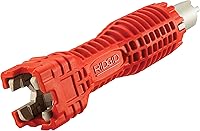
The RIDGID EZ Change Faucet Wrench suits repairs that require reaching compatible mounting nuts beneath the sink. Skip it if your repair only involves accessible parts above the counter and you already have the required tools.
Its notched handle accommodates common 2, 3, 4, and 6-tab basin mounting nuts. The cubed insert fits 5/8-inch, 3/4-inch, 7/8-inch, 15/16-inch, and 1-inch nuts.
The open slot clears supply lines, which helps when a conventional wrench has limited room to turn. Check your nut's shape and size, plus the space around it, before choosing the tool.
Seat the tool fully and support connected parts so they don't twist. Stop if a supply line turns with the nut or corrosion prevents controlled movement; extra leverage can turn a small repair into damaged plumbing.
How can you prevent repeat leaks after repair?
Check the repair under normal use before putting supplies back in the cabinet. Restore water slowly, then inspect with the faucet off, running, and swiveling.
Dry the connections between checks so old moisture doesn't hide a fresh drip. Recheck after using hot water and after operating a pull-down hose, if fitted.
Keep stored items clear of hoses and their moving weights. Wipe water from around the base so future leaks are easier to spot, and use cleaners approved for the faucet finish.
Don't tighten a dry fitting “just in case.” If low flow appears after repair, use our guide to low kitchen faucet pressure to check that separate symptom.
Should you repair or replace a kitchen faucet leaking at base?
Repair a kitchen faucet leaking at base when the failed part is clear and the correct replacement is available. Choose replacement when the faucet body is cracked, corrosion blocks repair, or suitable parts cannot be found.
Buy Oatey for a permitted putty repair on supported stone or porous surfaces, Harvey's for compatible metal applications, and the RIDGID wrench when matching mounting hardware needs better access. An internal leak needs the right seal or component before any of these supplies can help.
If you're replacing the fixture, measure the mounting holes, reach, and clearance with our guide to choosing a kitchen faucet. Then compare faucet types in the kitchen faucet guide.
For other sink and faucet repairs, start with our choose, fit, and fix guide.
Frequently asked questions
Why does my kitchen faucet leak around the base when I turn it on?
Worn spout seals or O-rings can let water escape around the base while the faucet runs. Water from a handle or hose can also travel there, so dry the faucet and watch for the first wet spot.
Use your exact model number to find the correct repair parts.
Why is water under my kitchen sink near the faucet?
Water near the faucet under the sink can come from supply connections, a pull-down hose, or water passing through the mounting hole from above. Dry each area and check with the faucet off, then running.
Shut off the water if a connection is actively leaking and safely accessible.
Can plumbers putty stop a kitchen faucet from leaking?
Plumbers putty can seal a stationary faucet base only when the faucet instructions permit it and the surface is compatible. It cannot repair an internal seal, cartridge, hose, or pressurized connection.
If the faucet uses a gasket, follow its installation directions rather than adding putty by default.
Should I replace a faucet that leaks at the base?
Repair the faucet when you can identify the failed part, obtain the correct replacement, and remove it without damaging surrounding parts. Replacement makes more sense when the body is cracked, corrosion prevents repair, or suitable parts are unavailable.
A leak from a separate supply line may not require faucet replacement.